Nothing really surprising here after reading Ireland_Europe_CO2_alignment_report_2025 recently, though there are some nice graphs that highlight the successes and failures with Ireland’s attempts to reduce GHG emissions.
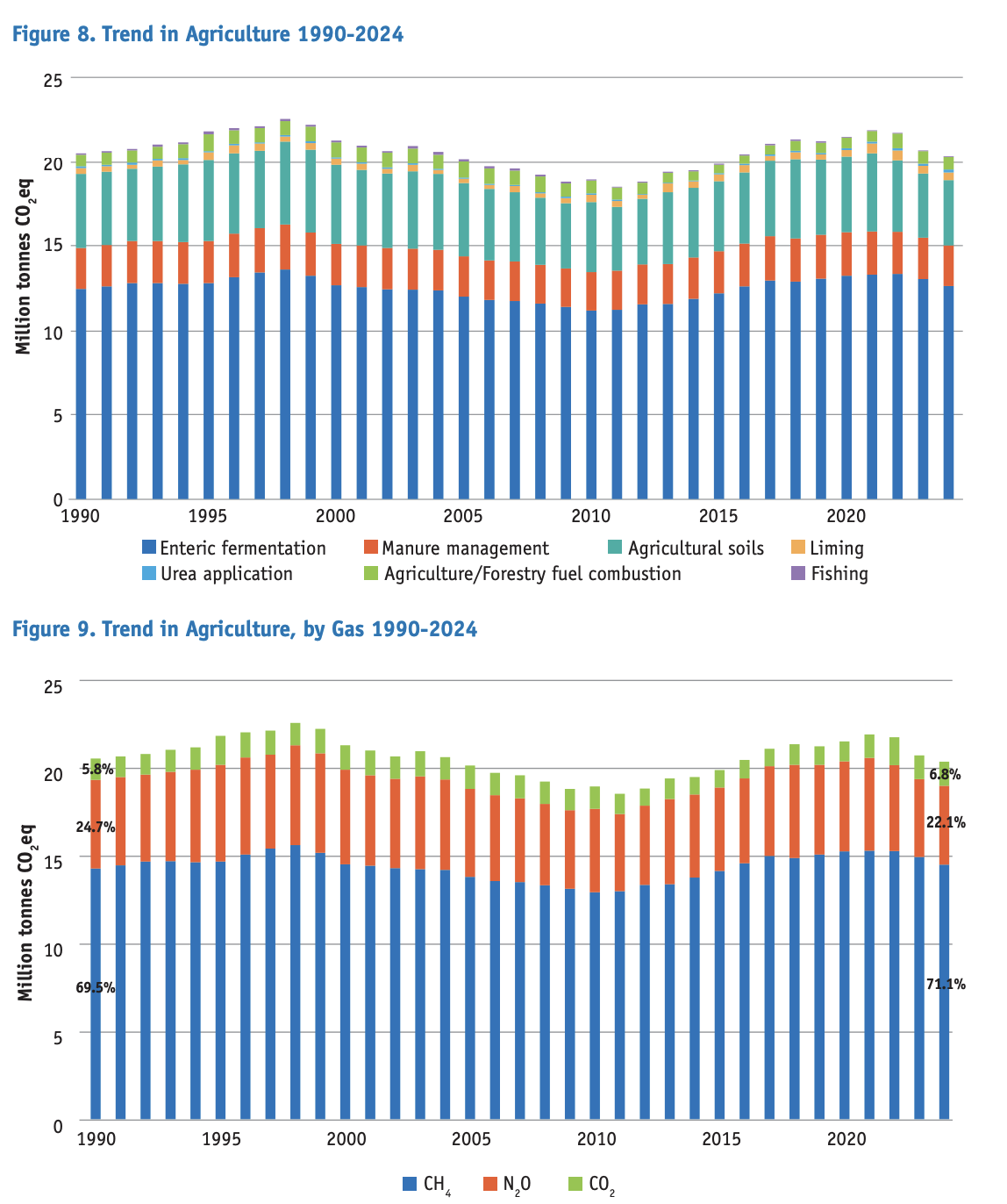
As usual, agriculture is the elephant in the room, being our largest emitting sector (38% of our GHG-equivalent emissions), with little apparent progress or a serious plan to fix things.
GHG emissions excluding LULUCF (Land Use, Land-Use Change, and Forestry - always seems to cause confusion/uncertainty with emissions accounting) are down 2% in 2024 vs 2023, BUT this is way behind where we should be:
- Our EU commitments
- A 42% reduction of ESR (Effort Sharing Regulations) emissions by 2030 relative to 2005. We’ve only managed 10.9% as of 2024.
- A 62% reduction of ETS (Emissions Trading Scheme) emissions by 2030 relative to 2005 (not given in this report, but taken from Ireland_Europe_CO2_alignment_report_2025). We’re at a 49.7% for 2024 so this is one of the few positive notes. This is mostly due to our high fraction of renewable energy and drop in cement production emissions.
- Our national commitments
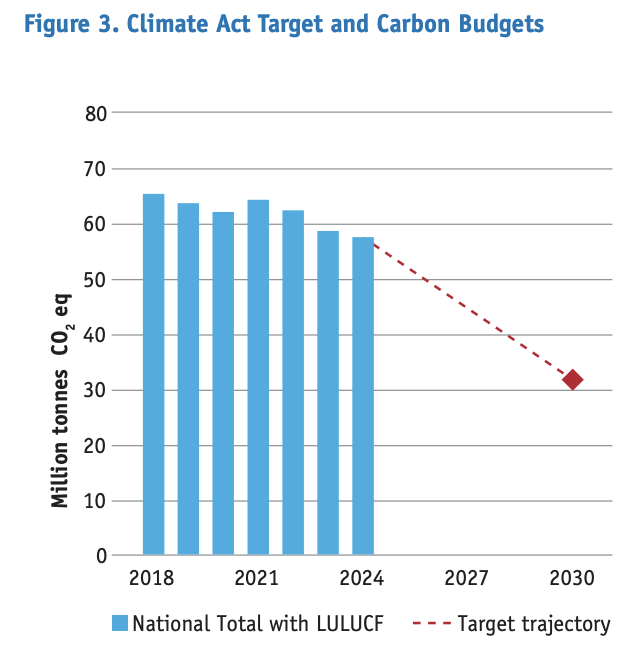
- A 51% reduction (including LULUCF) vs 2018 emissions by 2030. We’re only at a 12% reduction as of 2024.
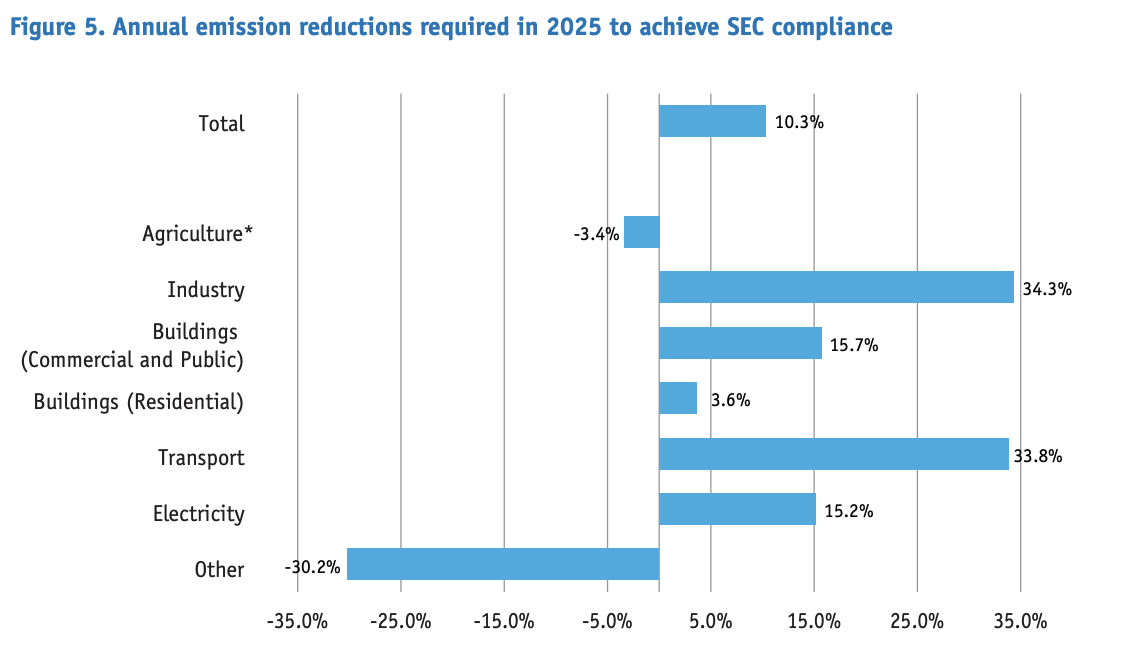
- We need to drop total emissions by 10.4% in 2025 to stay within our 2021-2025 budget. LOL.
- Sectoral emissions ceilings: we need reductions of 15%, 34%, 34%, and 16% in 2025 for the Electricity, Industry, Transport and Buildings sectors keep within Sectoral Emissions Ceilings (SEC). Agricultural and ‘Other’ sectors can probably meet their SEC.
Questions I have after reading the report
- What does “reduction in clinker production” mean? I assume we’re just importing it instead of changing how we make cement.
- This article says that all state funded projects now require low-carbon cement and a “requirement for at least 30% clinker replacement with low-carbon alternatives in concrete”.
- What’s driving the reduction in cattle and sheep herds?
- Can’t find a single answer, but this article makes it sound like sheep farming is low margin and precarious and any negative changes in price, labour availability, policy etc have an outsize impact.
- Are we going to do anything about Agriculture?
- I really hope so.
Sector by Sector Notes
Electricity generation
- GHG emissions decreased by 8.9% in 2024 vs 2023.
- Supply from renewables grew by 1.3% in 2024 vs 2023 but due to increased demand, the share in renewable energy generation decreased from 40.7% in 2023 to 39.6%.
- Imported electricity was 14.0% of electricity supply in 2024 vs 9.5% in 2023.
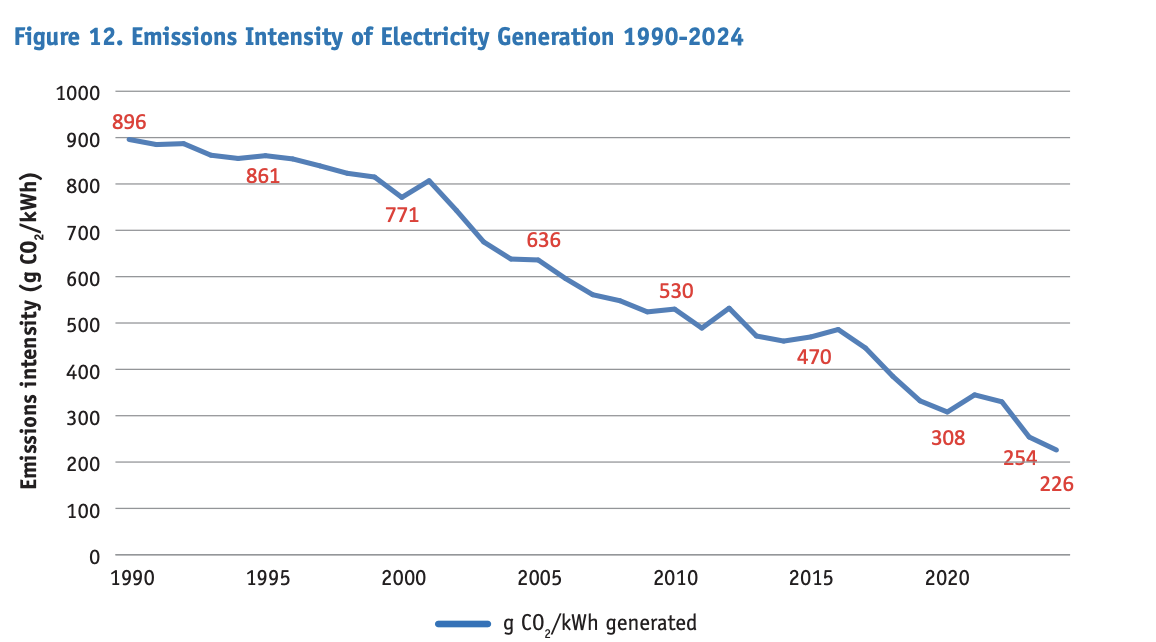
- Emissions intensity decreased to 226 g CO2/kWh vs 254 g CO2/kWh in 2023. It’s actually one of the more striking success stories of Ireland’s emission reduction efforts
- Since 1990, electricity consumption has gone up 175%, but generation emissions have gone dwon 37.5!!! This is due to increased gas plant efficiency (presumably combined cycle), increased renewables and interconnections. Conversely, in the same period, agriculture emissions have only dropped 0.8%.
- Imports accounted fro 14% of 2024 supply! I expect this will be higher for 2025 since the Ireland-Wales new interconnector went live in April.
Agriculture
- GHG emissions decreased by 1.7% for 2024 vs 2023.
- Most due to a 2.9% reduction in the cattle herd. Sheep herd also down by 7.9% (maybe good news for biodiversity?)
- 10.6% increase in fertiliser nitrogen use partially offset reduced cattle numbers on emissions.
- Our agriculture emissions are basically down to cows (CH4)+fertiliser(N20)
Transport
- GHG amissions decreased 1.2% in 2024 vs 2023. This is 5.4% below 2019
- 16% increase in use of biofuels contributed to the majority of this emission reduction. ie: not EVs, though EV increases helped offset emissions growth from 4.1% increase in the national vehicle fleet.
Residential
- GHG emissions increased 4.9% in 2024 vs 2023
- Usage of peat declined by 8.6% vs 2023, consumption of all other fossil fuels increased. 2024 having 6.3% more heating degree days than 2023.
Heavy industry
- Manufacturing Combustion and Industrial Processes emissions decreased by 4.6% in 2024 vs 2023 due to declines in coal and oil usage.
- Cement sector emissions decreased by 15.6% due to “reduction in clinker production” -
LULUCF
- The report notes that we are way behind the Carbon Action Plan 2025 (CAP25) goals for afforestation at 1,573 hectares in 2024, but doesn’t go into any more detail.