https://www.nature.com/articles/s41598-025-20447-2
I came across this paper shortly after reading this heatmap article about an Israeli company developing a non-sulfur particle and distribution system for solar radiation management and that they think will be good to go by 2030. This paper makes me more sceptical that is is physically and economically doable (never mind the political challenges). That said, I do think some form of solar radiation management is going to happen, and much sooner than we might expect. I don’t love it, and I hope a lot more research happens first, but it’s too easy a “fix” for capitalism to ignore.
Abstract - The use of reflective aerosols in the upper atmosphere (stratospheric aerosol injections, SAI) to limit incoming sunlight has been proposed as a potential means of countering anthropogenic climate change. Such a strategy ideates from observed cooling effects due to sulfate aerosol formation following volcanic eruptions. Solid mineral candidates have been proposed as a sulfate alternative, potentially lowering environmental risks like ozone depletion and absorption of radiation. The bulk of SAI modeling literature focuses on optimal deployment scenarios, in which practical constraints— microphysical, geopolitical, and economic—are not considered. Here, we explore several key micro and macroscopic aspects of deployment that may directly increase risk, and the degree to which technical and governance approaches could be levied to offset it. We find that the risk and design space for SAI may be considerably constrained by factors like supply chains and governance. Logistical and technical considerations, most significantly difficulties in dispersing solid aerosols at scale in the desired size range, and the radiative properties of potentially formed aggregates, notably introduce uncertainties in the outcomes of solid-based SAI strategies more so than sulfate. We conclude that the design space for a “low-risk” SAI strategy, particularly with solid aerosol, may be more limited than current literature reflects
And from the companion release article: https://www.eurekalert.org/news-releases/1102670
There are a range of things that might happen if you try to do this—and we’re arguing that the range of possible outcomes is a lot wider than anybody has appreciated until now.
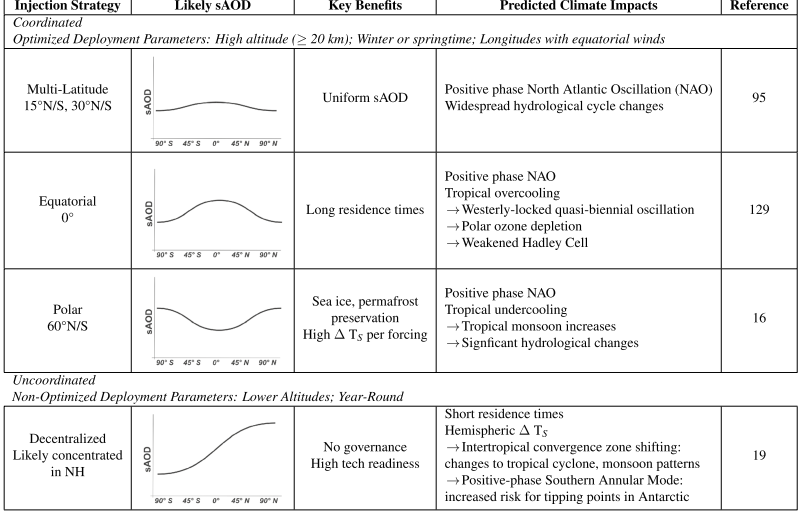
The authors step through the various factors that affect the risks and chances of success of stratospheric aerosol injection: altitude, longitude, seasonality, amount and method of injection (constant or pulsed), and possible materials.
On longitude:
SAI concentrated in polar regions would likely disrupt tropical monsoon systems. Releases concentrated in equatorial regions could affect the jet stream and disrupt atmospheric circulation patterns that conduct heat towards Earth’s poles. … These variabilities suggest that, if SAI takes place, it should be done in a centralized, coordinated fashion. Given geopolitical realities, however, the researchers say that is unlikely.
For the material aspect they both look at the physics (reflectivity, tendency to clump, how to create the desired streams), and the economics (cost, supply, price elasticity).
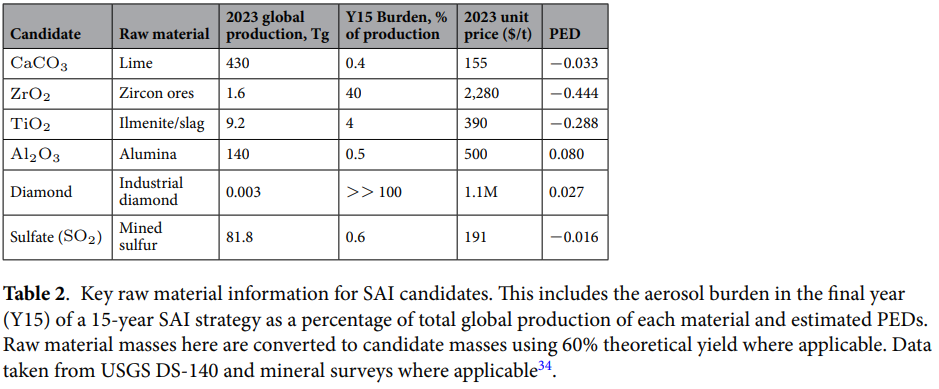
CaCO3, alpha alumina (Al2O3), TiO2, cubic zirconia (ZrO2), and diamond: all of these have some combination of problems either in cost/supply, undesired aggregation (clumping), or difficulty with dispersion, and it doesn’t take much to make them less effective/more risky than the default choice of sulphates, even though that comes with pollution problems.
Notes
- sulfate aerosol can induce stratospheric warming due to absorption of upwelling infrared (IR) radiation and lead to ozone depletion via subsequent dynamical changes and surface reactions that convert stable halogen reservoir species to photolabile forms involved in catalytic ozone destruction.
- Other aerosols considered: CaCO3, alpha alumina (Al2O3), TiO2, cubic zirconia (ZrO2), and diamond. But there has been minimal testing and modelling has not been sufficient.
- Possible stratospheric aerosol injection (SAI) deployment strategies
- sAOD = stratospheric aerosol optical density
- Injection at higher altitude means
- longer time in higher stratosphere -> stronger radiative forcing, also modelled to produce less stratospheric warming and water vapour.
- BUT, seems like there is an issue of diminishing returns at higher altitudes.
- And may be more damaging to ozone layer
- Longitude
- May have a significant impact on particle lifetime when injecting at lower altitudes.
- Season
- Winter injections have longer residence times
- Time injections such that particles reach optimal scattering size when needed the most, eg: inject in spring for maximum cooling effect in summer.
- Magnitude
- Higher total magnitude means higher environmental risk
- Instantaneous magnitude (ie: pulsed or continuous injection) has different climate impacts for different aerosols.
- Diminishing returns for cooling above a certain magnitude (eg: 20TgS/year). From particle coagulation or sedimentation.
- The optimal deployment scenario likely requires high-altitude injections, or slightly lowered at longitudes with equatorward winds. These should be either pulsed, high-local flux injections (in the case of SO2) or continuous, low local-flux injections (in the case of solid aerosol) focused in the winter or spring months.
- Deployment at multiple mid-latitudes is optimal to limit the impacts associated with nonuniform sAODs
- Supply chain constraints
- PED: price elasticity of demand
- Solid aerosol dispersal
- Have a tendency to clump
- Need to reduce flow rates to limit clumping, which makes it more expensive to disperse the required amounts.
- But then need high pressure and the equipment to do that on any plane doing the dispersal. That has cost and safety implications.
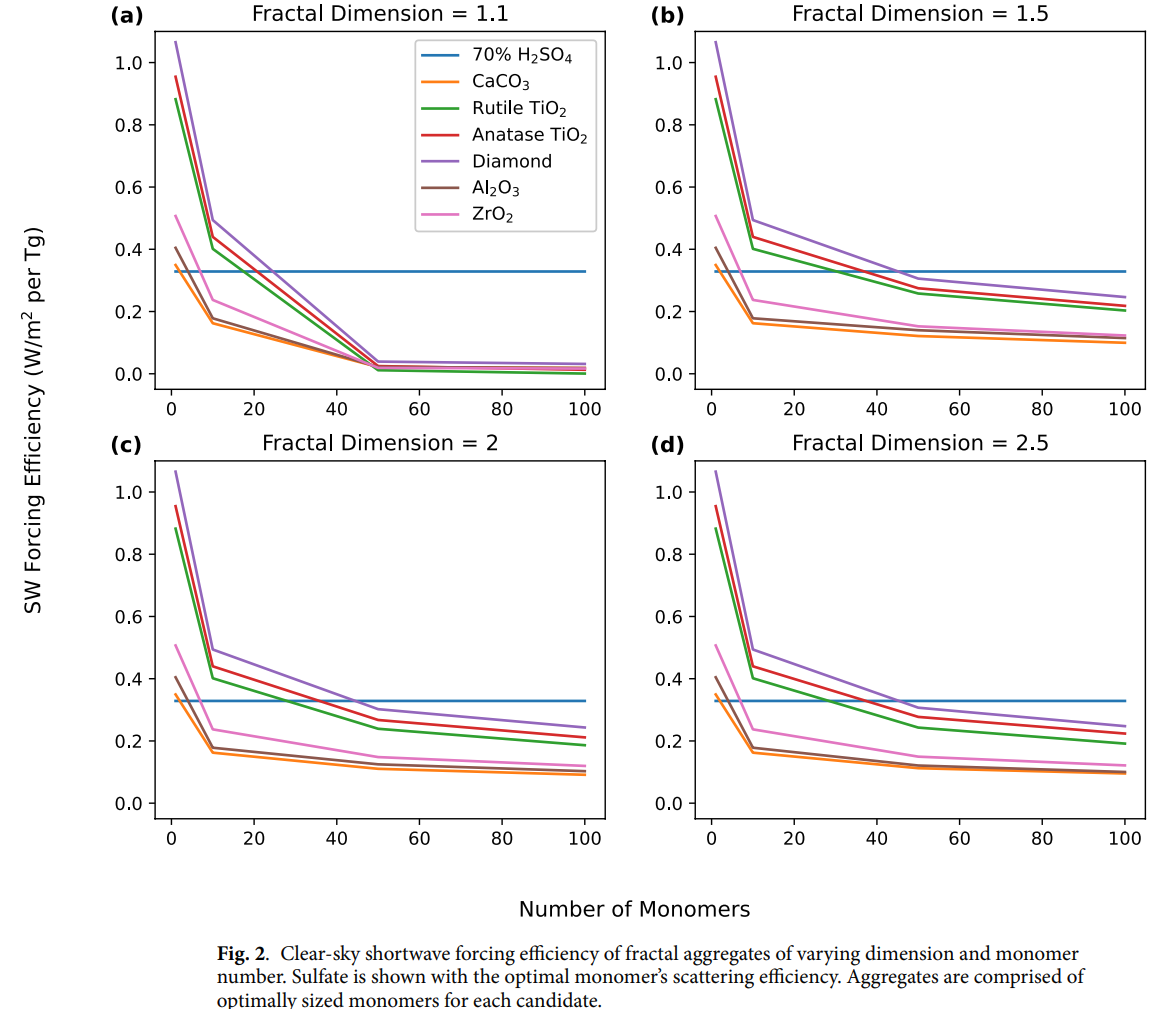
- Aggregating force
- Though sub-micron monomers may scatter sunlight up to 3x as effectively as sulfate aerosol, aggregates, if formed, will likely be much less effective
- Increased fractal branching also makes drop in effectiveness from aggregation worse
- In the case of perfect injection and dispersion (e.g. monomer dispersal), solids do have the capability to lower sulfate-associated risk. However, a less-optimal solid injection and dispersion strategy, in which aggregation occurs, extends the risk space significantly beyond the lower bound of most sulfate scenarios.