https://cms.eirgrid.ie/sites/default/files/publications/EirGrid-Price-Review-6-Business-Plan-2026-2030-July-2025.pdf https://consult.cru.ie/en/system/files/flipbook_pdf/CRU202586%20-%20Price%20Review%20Six%20-%20Summary%20Paper%20%283%29.pdf
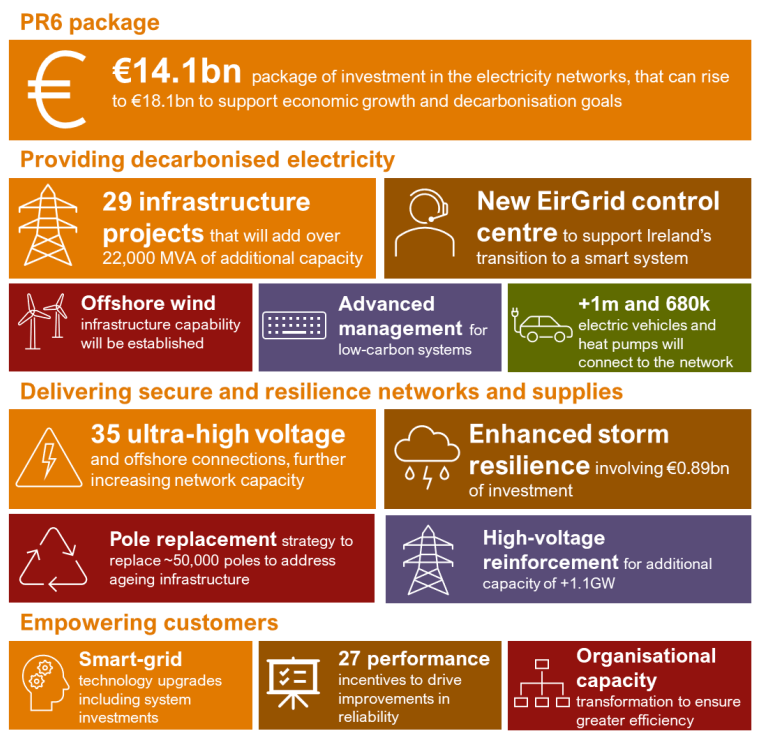
Every five years, EirGrid develops a Business Plan for the Energy Regulator, the Commission for Regulation of Utilities (CRU), for the operation and development of the transmission system for the forthcoming five years. This document is a plain English summary of our Business Plan, ‘Price Review 6’ or ‘PR6’, which details our key priorities for the PR6 period (January 1st 2026 to December 31st 2030), along with how much achieving these priorities is estimated to cost.
Notes
- Eirgrid (Transmission System Operator, TSO) plans, manages and operates the transmissiwon grid which connects large scale generation and consumers. Also the asset owner of the offshore transmission grid (and offshore windfarms?)
- ESB Networks (Transmission Asset Owner, TAO). Own the onshore transmission grid and are responsible for its construction and maintenance in accordance with the development plans set out by EirGrid. Also the DSO which means they plan, manage, and operates the distribution network.
- Every five years, EirGrid and ESB Networks (TAO) each develop Price Control Business Plans for Transmission as per our respective roles. Together, we ensure these plans are aligned with a particular focus on any dependencies between the two.
- CRU says Eirgrid needs to achieve
- Decarbonised electricity: new technologies, Celtic interconnector, transmission network programs, offshore windfarms.
- Secure and Resilient Networks and Supplies: cyber security, changes to national grid control centre.
- Empowered customers: consultations.
- CRU says to do this, should focus on
- fast infrastructure delivery
- better system efficiency
- security compliance
- smarter/flexible/more digital networks
- Customers put at the centre
- build the ability to own and operate offshore transmission
- Areas of focus
- Digital transformation: secure and resilient IT systems. Rapid access to info to stakeholders.
- Tech resilience and modernisation. Decrease downtime to increase operational efficiency.
- Cyber security.
- Power system capability enhancements.
- Only 75% of renewable capacity can be accommodated on the grid at one time (that high?)
- Target is 95%
- TSO-DSO coordination
- Celtic Operational Readiness Programme. 700MW, 575km. Need to prepare grid and market operations.
- Control centre infrastructure. “grow and evolve our control centre infrastructure to ensure future readiness for managing new and additional functions such as the operation of the offshore system and increased interconnection”
- Onshore Network Plan. Make the grid renewable ready. Reinforcements, upgrades, new infrastructure. 369 projects. 876 km of upgrades to existing lines, 181 km of new overhead lines, the replacement of 55 km of underground cables with 319 km of new underground cables and 40 new/expanded substations.
- Offshore Network and Readiness Plan.
- Growing the workforce.
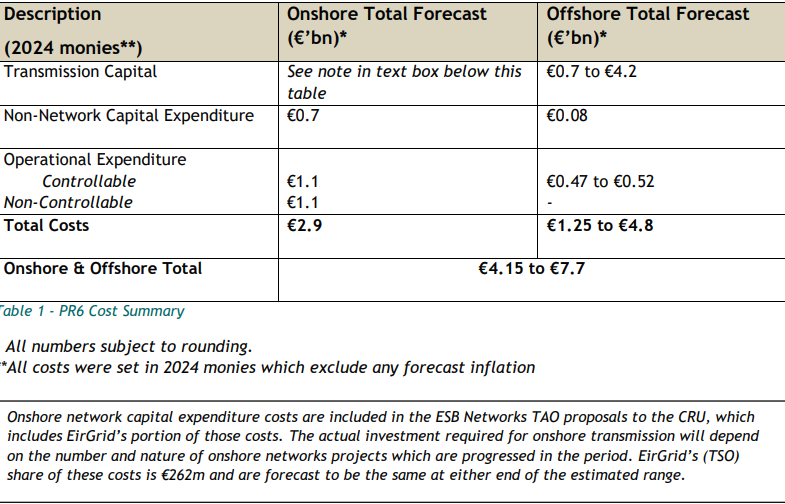
- Non-network capital expenditure == “investment in the development of our core IT systems, to support onshore and offshore activities, critical all-island programmes and PR6 Delivery Roadmap programmes”
- “The existing typical cost to households arising from: controllable TSO costs, funding for non-network capex, and funding for offshore network capex is €57 per year. This is approximately 3% of a household’s total electricity bill, which is, on average, just over €1,900 per year (incl. VAT). EirGrid also covers non-controllable costs and the cost of system services through the Transmission Use of System Charge (TUoS). The cost of system services will be recovered in the future via the Future Arrangements for System Services (FASS) Programme charges. Combined, these would add approximately another €60 per year, so another 3% of the overall bill.”