Other notes in this series from Kevin Kircher’s Distributed Energy Resources class are here.
As a result of time pressure I’m easing up on the detail in the notes and bundling together several lectures.
The first in these lectures continues the previous discussion of thermal circuits and how more complicated circuits (2R2C and then nRnC) can be modelled and how air mass and building mass can be viewed as separate thermal batteries that vary on different time scales. It also discusses different heating control mechanisms including thermostats and how to model them.
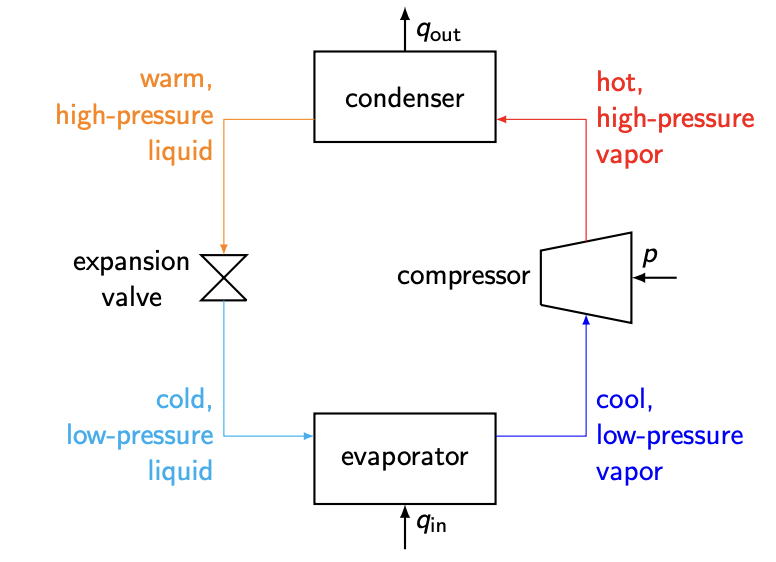
The second lecture is an introduction to heat pumps (including backwards heat pumps, aka: air conditioners): both the underlying technology and how to model them for the purposes of sizing for heating/cooling of a given building.
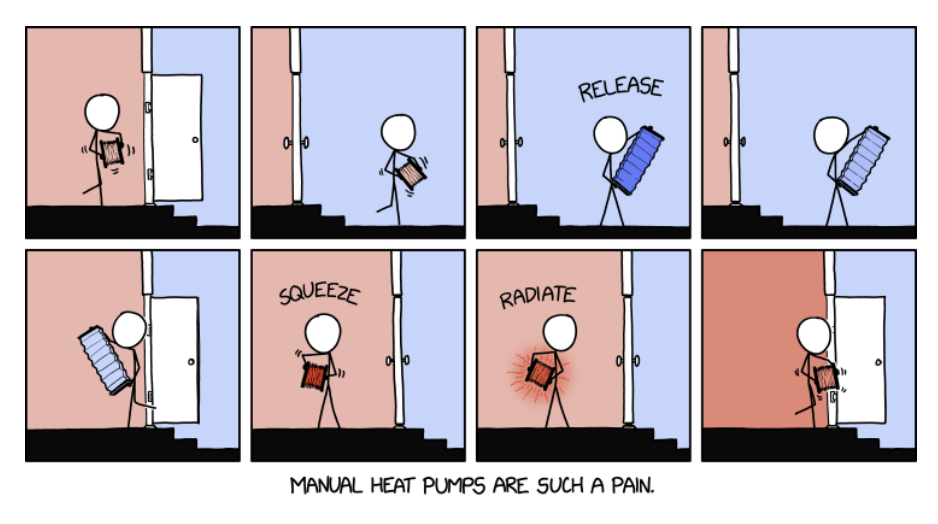
I can’t believe I hadn’t seen this XKCD before:
Notes
- Buildings part 2
- 2R2C circuit:
where:
- is energy storage capacity of the wall materials (mass)
- shows the coupling between the indoor air temp and the mass temperature
- Two-timing: the indoor temperature typically changes much faster than the mass temperature . So we can approximate
- only looking at fast time scale: (a constant) for all
- only looking at slow time scale: for (almost all)
- Both time scale simplifications turns the 2R2C model back into a 1R1C model.
- mRnC models can be simplified and treated similarly to 2R2C
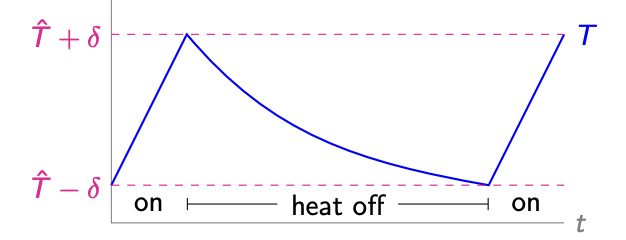
- This is what thermostatic control looks like (target temperature not shown) - sawtooth pattern between min/max targets. Typical when have heating/cooling equipment that can only be off/on:
- Buildings as thermal batteries
- It’s actually common across DER technologies for them to be model-able as batteries. Where the capacity is based on the diff between the target and max/min acceptable temp.
- Consider indoor air and thermal mass as separate batteries (with different time scales as described above)
- Mass thermal capacity typically an order or magnitude larger than the air.
- Mass is charged (heated) by air, so constraints on the air temperature limit the charging power of the mass. Air charging power is limited by heating/cooling equipment.
- Typically US house ~50kWh thermal battery (assuming an acceptable temperature range of 2C and standard building materials)
- BUT a heat pump can give 3kWh of heat for 1kWh of electricity. So comparing thermal and electric batteries is not straightforward.
- Heating, ventilation, and air conditioning
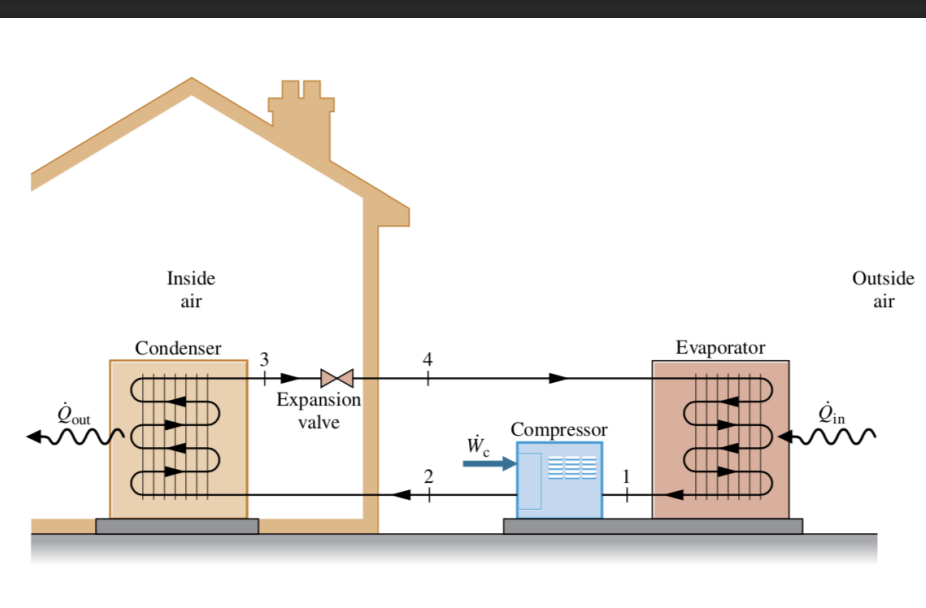
- A heat pump:
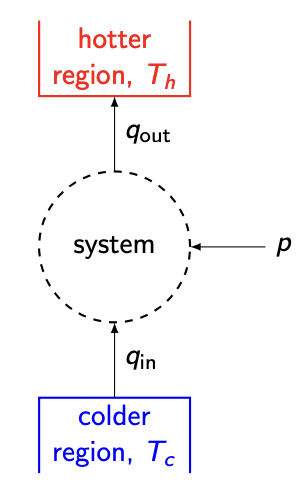
- coefficient of performance:
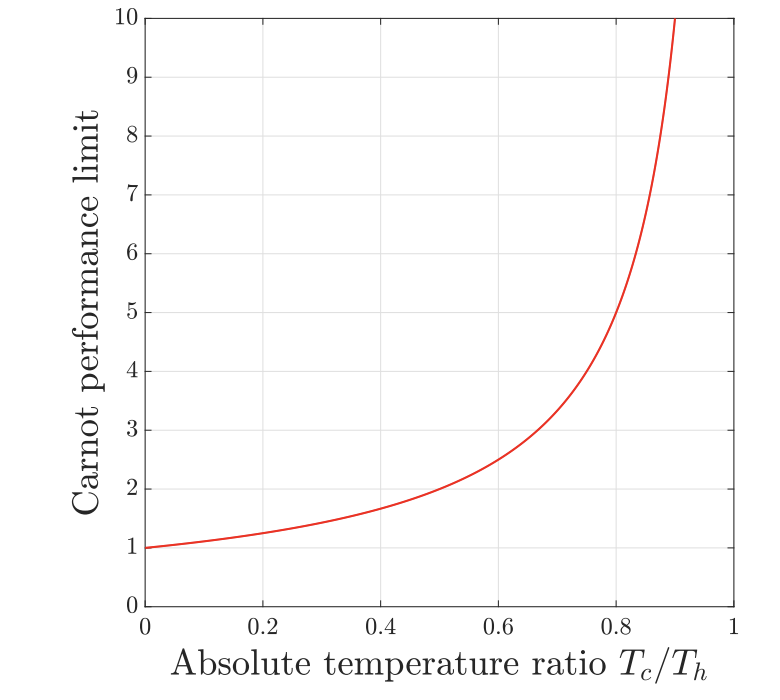
- With Carnot performance limit: with and in Kelvin.
- Note that the curve is exponential, so you get increasing gains as you move to the right (smaller delta between source and destination temperature.) This is why heat pumps can struggle with extreme cold.
- Airconditioning
- A heat pump in reverse
- Can also dehumidify
- Sizing for heating and cooling
- estimate overall indoor-outdoor thermal resistance
- get design outdoor temperature
- set design indoor temperature to occupant preference
- pick plausible fro ~4am
- size to steady-state heat load in design conditions:
- Where is the “oversize ratio” and is ~1.2 to 1.5, typically
- for cooling:
- where should be plausible for sunny afternoon
- Can size the resultant system to either be large enough to serve the max of heating and cooling (but may then be quite large), or undersize for heating (which is typically the largest component) and then fall back to some form of backup heating, eg: resistive, heat storage, gas etc.
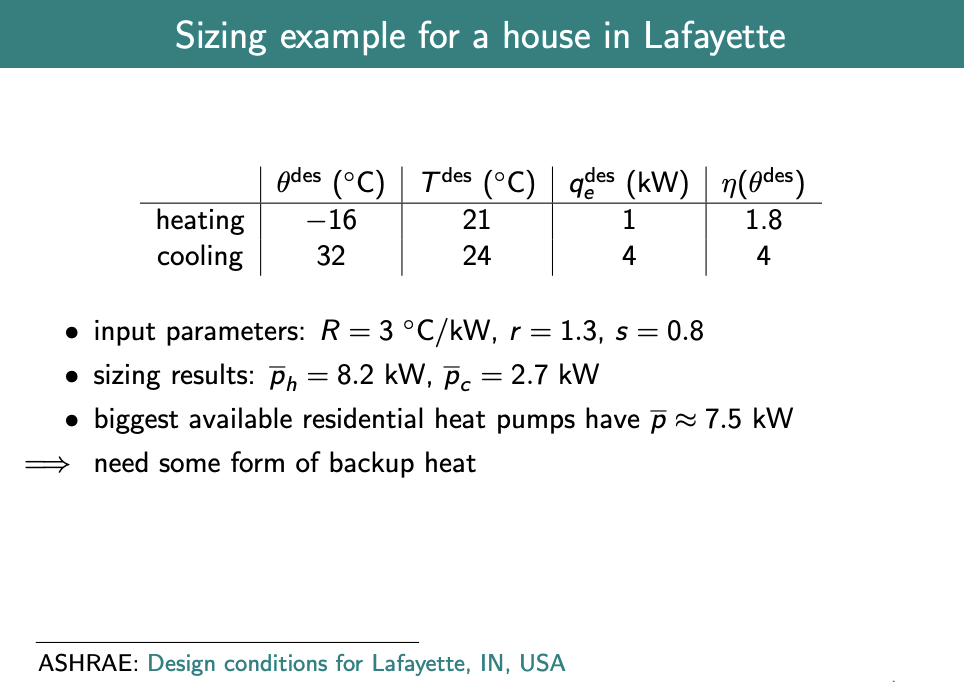
- Example: