Other notes in this series from Kevin Kircher’s Distributed Energy Resources class are here.
Summary
Lecture 5 covers modelling of batteries and EVs which are just a type of battery that come with some extra constraints.
This was a fun one; some simple models with real world applications and use of bits of theory from lectures 3&4.
Notes
Homework
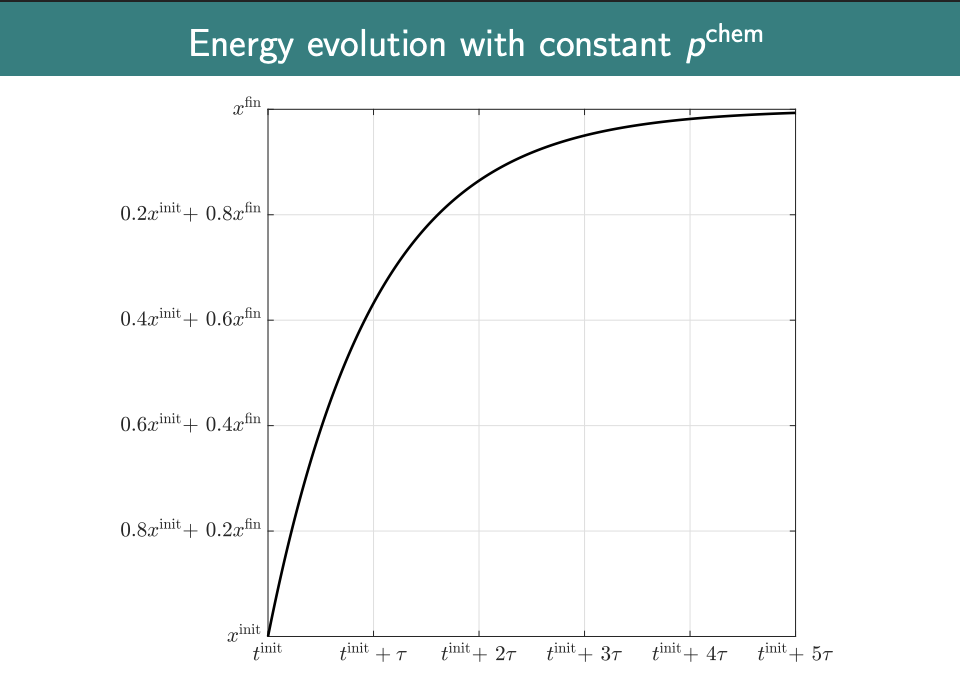
- Show that with uniform time step and piecewise constant , the continuous-time battery model can be written in discrete time as where
- From last week, if we have the continuous-time vector LDS:
then the general discrete-time LDS equation is
- where and if is invertible:
- And the scalar equivalent
- where
- $b(k) = (a(k) − 1)\tilde{b}(t_k)/\tilde{a}(t_k)$$
- In this case
- So
$x(k+1)=e^{-\frac{\Delta t}{\tau}}x(k) -\tau(e^{-\frac{\Delta t}{\tau}} - 1)p^{chem}(t)$$
if we let , then that gives us
- In the special case of a battery with no self-dissipation, the continuous-time model simplifies to Show that with uniform time step and piecewise constant , a discrete-time version of this model is
Since is piecewise constant.
- The charge state of a battery, initially at 80% of its energy capacity, drops to 50% of its energy capacity after 30 days unplugged and unused. What is the battery’s self-dissipation time constant?
- Suppose an electric vehicle has an energy intensity of and a comparable gasoline vehicle gets miles per gallon. If burning one gallon of gasoline causes pounds of CO2 emissions (including upstream emissions associated with oil extraction and processing), what is the break-even CO2 intensity of electricity (in units of g/kWh) at which the two vehicles cause the same CO2 emissions per unit distance driven? By what percent would the EV reduce CO2 emissions from driving with the US-average CO2 intensity of electricity, 345 g/kWh? With the average CO2 intensity of electricity in your home state or country? What factors not considered here might complicate this analysis?
- ICE CO2:
- EV CO2 for breakeven:
- By what percent would the EV reduce CO2 emissions from driving with the US-average CO2 intensity of electricity, 345 g/kWh?
- EV emissions/km =
- With the average CO2 intensity of electricity in your home state or country?
- currently 406g/kWh per https://app.electricitymaps.com/zone/IE/72h/hourly
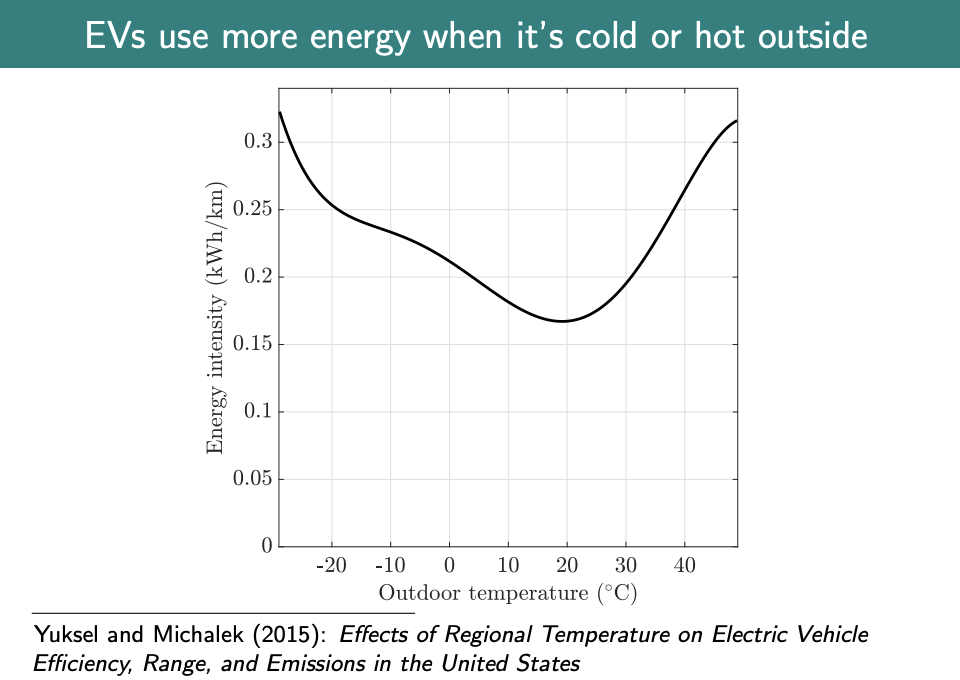
- What factors not considered here might complicate this analysis? Regenerative braking, temperature variation of energy intensity of EV, varying over time.
- Suppose someone commutes two miles each way, five days per week, riding an electric bike with an energy intensity of . If they work 50 weeks per year and electricity costs 0.15 $/kWh:
- How much do they spend on bike electricity per year?
- dollars
- Compare this to the annual fuel cost from the same commute in an automobile that gets 30 miles per gallon with a fuel price of 3 $/gallon
- dollars
- Like lecture four, there was some not very interesting python scripting.
Batteries
- A simple battery model
- is the stored chemical potential energy
- is the self-dissipation time constant. This for an ideal battery
- is the chemical charging power, or discharging if - ie: electrical power input/output.
- Electrical charging/discharging power is
- are the charging and discharging efficiencies.
- Discrete-time battery model
- Battery constraints
- is the chemical energy capacity
- is the electrical charging power capacity
- is the electrical discharging power capacity
- So then power constraints are
- unused, a typical battery might lose ∼1 to 3% energy per day
- is called the round-trip efficiency, typically ~0.9, and and are both ~0.95
EVs
Just a battery with wheels (and thus special charging/discharging conditions)
- is energy intensity of driving (like MPG for ICE cars). Typically 0.15 - 0.4 kWh/km. Ebikes ~0.005kWh/km
Temperate profile
plugged in indicator
with for EVs without bidirectional chargingif (meaning the EV is plugged in) and we want to charge to full:
- This places at when the battery is nearly full
if z(k) = 1 and we want to charge steadily to meet a deadline: